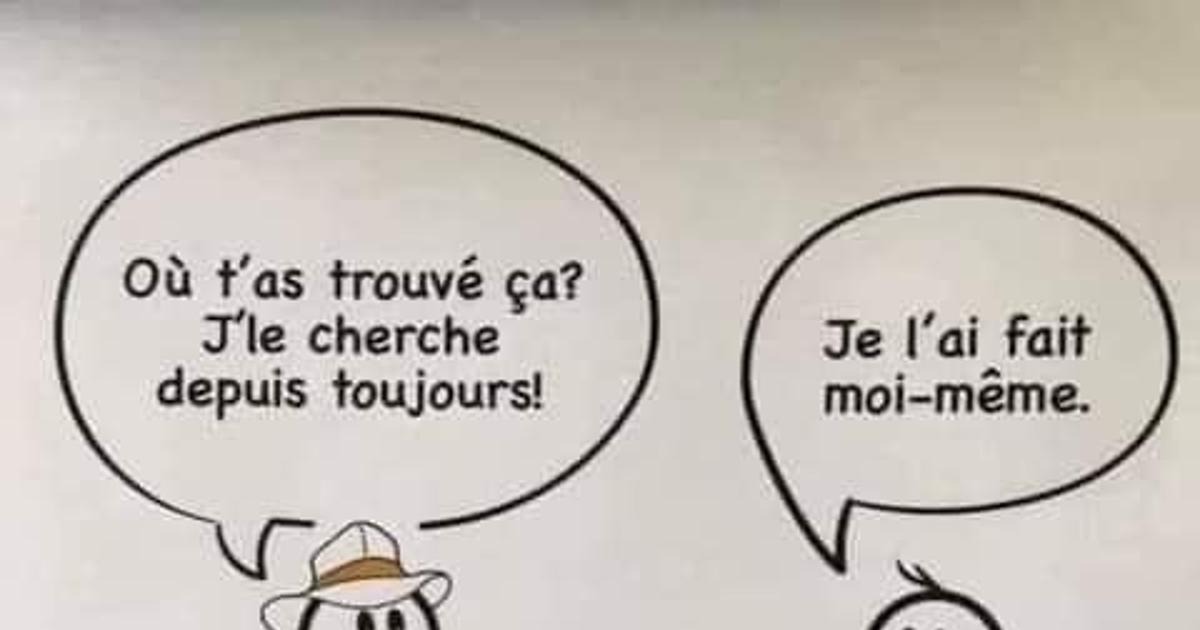
Ah, bonjour, mes amis! Settling in nicely? Grab a coffee – un petit café crème, peut-être? – and let’s chat about something deliciously French. Something that might just spark a little joie de vivre in your day. We’re talking about “Je l’ai trouvé(e).”
Doesn’t it just sound lovely? But what does it mean? Well, literally, it translates to “I found it.” Simple enough, right? But like so many things in French, there’s a little nuance, a little je ne sais quoi, that makes it special.
See, the little “l’” in “Je l’ai trouvé(e)” is a pronoun. It's replacing something else. And that’s where the trouvée bit comes in.
Trouvé vs. Trouvée: The Gender Bender!
Remember those pesky grammatical genders in French? Le and La? They're at play here. If the thing you found is masculine, you’d say “Je l’ai trouvé.” If it's feminine, you’d say “Je l’ai trouvée.”
Easy peasy, lemon squeezy, right? Well, mostly! Let’s break it down with some examples.
Finding Le Livre (The Book)
Imagine you’re searching for a book. Perhaps a well-worn copy of Le Petit Prince. After a frantic search behind the sofa cushions and under a mountain of blankets, you finally spot it! Eureka!
What do you say? You’d exclaim, "Je l'ai trouvé!" because "livre" (book) is a masculine noun.
Think of it like this: "I found him (the book)". The 'him' being the masculine le replaced by the l’.

Finding La Clé (The Key)
Now, let's say you’re in a panic. You're late for a very important date (maybe a date to enjoy a croissant and coffee? ☕). You can’t find your keys! Mon Dieu!
You tear the house apart, and then, finally, triumphantly, there they are! Sparkling in the sunlight, hanging from the doorknob.
This time, you'd declare, "Je l'ai trouvée!" Why? Because "clé" (key) is a feminine noun.
In your mind, you're saying "I found her (the key)." La clé becoming l’ and influencing the past participle.
See how that works?
Beyond Lost Objects: A Deeper Meaning
But "Je l'ai trouvé(e)" isn’t just about finding lost objects. It can also express finding a solution, a feeling, or even yourself.
Imagine you've been struggling with a difficult problem at work. Endless meetings, mountains of paperwork... it's been a nightmare!
Then, suddenly, a brilliant idea strikes! You have the solution!
You could confidently proclaim, "Je l'ai trouvée, la solution!" (I found it, the solution!) Because "solution" is feminine.
Or perhaps, you've been feeling lost and confused, unsure of your path in life. After some soul-searching, a deep conversation with a friend, or maybe just a quiet moment of reflection, you finally understand what you need to do.

You could say, with a sense of relief and self-discovery, "Je me suis trouvé(e)!" (I found myself!). This one uses the reflexive pronoun "me," but the principle of grammatical agreement remains. Are you male or female? Do you need the "e" at the end?
See how versatile it is?
Why This Matters (And Why You Should Care!)
So, why is all of this important? Well, besides impressing your French-speaking friends with your grammatical prowess, using "Je l'ai trouvé(e)" correctly shows that you pay attention to detail. It shows respect for the language and a deeper understanding of its nuances. And that, my friends, is something to be proud of!
But more than that, mastering these little details helps you to truly connect with the language. It allows you to express yourself more precisely and authentically. It opens up a whole new world of communication and understanding.
Think of it like adding spices to a dish. A little sprinkle of grammatical accuracy can transform a simple sentence into something truly flavorful and satisfying.
![Je l'ai trouvé, Je l'ai trouvé [ adoration Et Louange ] Sr DESCA LINDA](https://i.ytimg.com/vi/cIaBENCxo4M/maxresdefault.jpg)
Don’t be afraid to make mistakes, though. Everyone does! It’s part of the learning process. The important thing is to keep practicing, keep listening, and keep trying. The more you immerse yourself in the language, the more natural these things will become.
A Little Trouvaille of Happiness
And finally, there's something inherently joyful about finding something you've been searching for. Whether it's a lost key, a brilliant idea, or a sense of inner peace, that moment of discovery is always a cause for celebration.
So, the next time you find something, anything, remember that little phrase: "Je l'ai trouvé(e)!" Say it with enthusiasm, say it with a smile, and let it fill you with a sense of accomplishment and joy.
Because sometimes, it's the little things, the little trouvailles, that make life so wonderful. N'est-ce pas?
Now, who's up for another coffee? And maybe a little pâtisserie to celebrate our newfound linguistic knowledge?


![Je l'AI trouve, Je L'AI trouve [ adoration Et Louange ] frère Damy](https://i.ytimg.com/vi/YOgmuAPGR_M/maxresdefault.jpg?sqp=-oaymwEmCIAKENAF8quKqQMa8AEB-AH-CYAC0AWKAgwIABABGDQgSih_MA8=&rs=AOn4CLApIyQEzIBoTMKXVbBbIuxLVvzPmA)